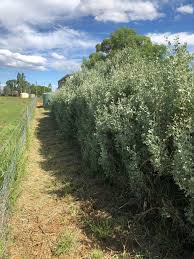
What is Australian Namkeen Saltbush?
Australian Namkeen Saltbush is Atriplex nummularia (Old Man Saltbush), a perennial shrub used as a supplementary fodder source on land or with water too saline or dry for conventional forage.
What is the scientific name of Australian Namkeen Saltbush?
The scientific name of Australian Namkeen Saltbush is Atriplex nummularia.
Is Australian Namkeen Saltbush perennial or annual?
Australian Namkeen Saltbush is a perennial species.
Is Australian Namkeen Saltbush suitable for Pakistan?
Yes — Australian Namkeen Saltbush is suited to Pakistan's drier and, where relevant, saline growing conditions. See the regional suitability table on this page for specifics.
Which areas of Pakistan are suitable for Australian Namkeen Saltbush?
Australian Namkeen Saltbush is rated Suitable for: Thal, Sindh, Balochistan. Other zones may be Conditional or Not Recommended — see the full regional suitability table on this page.
Can Australian Namkeen Saltbush grow in sandy soil?
Based on its soil profile (Saline and degraded soils), check the soil notes above for sandy-soil suitability.
Can Australian Namkeen Saltbush grow in saline soil?
Salinity tolerance is rated Very High. This is one of the more saline-tolerant options in the catalog.
What TDS/EC water can Australian Namkeen Saltbush tolerate?
Extremely high salinity tolerance — the reference "saline land" fodder shrub, tolerating genuinely saline soil and brackish irrigation water where most fodder crops fail.
How much water does Australian Namkeen Saltbush require?
Thrives on as little as 200–400mm/year — one of the lowest water requirements in the catalog once established. Irrigation need is rated Very Low.
How many plants should I grow per acre?
Block planting on saline land: 1.5×2m spacing, approx. 1,300–1,600 plants/acre. Can also be broadcast-sown for ground cover at lower establishment cost.
How much fodder can Australian Namkeen Saltbush produce per acre?
One of the highest fodder-value-per-acre options on truly saline ground: an established acre can support roughly 15–20 sheep or goats through rotational grazing, given saltbush's mineral-rich, high-protein leaf.
What is the crude protein content of Australian Namkeen Saltbush?
Commonly cited around 15–20% crude protein (DM), with high mineral/ash content typical of halophyte fodder — valuable as a mineral-rich supplement rather than sole feed. Confirm with your own feed test.
Is Australian Namkeen Saltbush suitable for goats?
Yes.
Is Australian Namkeen Saltbush suitable for sheep?
Yes.
Is Australian Namkeen Saltbush suitable for cattle?
Australian Namkeen Saltbush is not typically used as primary cattle fodder.
Does Australian Namkeen Saltbush fix nitrogen?
No — Australian Namkeen Saltbush does not fix nitrogen.
How do you germinate Australian Namkeen Saltbush seeds?
Direct broadcast or row-sow onto saline ground, 0.5–1cm deep; no scarification usually needed. Alternatively strike stem cuttings in a nursery bed.
Does Australian Namkeen Saltbush need seed treatment?
Propagated from seed, and also readily from stem cuttings taken from established bushes — cuttings are a fast way to multiply proven, locally adapted plants.
How long does Australian Namkeen Saltbush take to establish?
Usable for light grazing within 6–9 months; full production by year 1–2. Persistent and productive for 10–15 years on saline ground where little else survives.
How long does Australian Namkeen Saltbush live?
10–15 years
What is the best planting density for Australian Namkeen Saltbush?
Block planting on saline land: 1.5×2m spacing, approx. 1,300–1,600 plants/acre. Can also be broadcast-sown for ground cover at lower establishment cost.
Can Australian Namkeen Saltbush grow without irrigation?
Yes, once established — drought tolerance is rated Very High.
Is Australian Namkeen Saltbush drought tolerant?
Drought tolerance is rated Very High.
Is Australian Namkeen Saltbush frost tolerant?
Frost tolerance is rated High.
What is Australian Namkeen Saltbush mainly used for?
Primarily: Fodder, Soil reclamation.